


Remember when I ran you through the way we track our finances? Well you can consider that a warm up to this post. I will be referring to that post regularly so if you have not read it yet, it might be time to do that. Today I am going to show you how we do our MONTHLY cash flow and bank reconciliation.
This is super important. Last time I showed you how we store our invoices and receipts. Now I am going to show you how to use them for your cash flow statements. This is really important for tax time, but it is also useful as a way to see how your business is running from a financial point of view. So shall we begin. Queue Days of Our Lives intro, “Like sands through the hour-glass, so are the days of our lives” – don’t judge me.
Bank reconciling is pretty easy and straightforward when you have everything you need, like receipts and invoices. Basically it is the process of checking the values on your bank statement match your receipts and invoices. For example, if your bank statement shows income of $500, you should have an invoice of $500. Similarly, if your bank statement shows an expense of $100, you should have a receipt for the same value (or a number of receipts equal to the value). You should mark on your bank statement to see if you have anything missing. This is a great way to find which invoice(s) have not been paid and which receipts are missing. If a receipts is missing you should probably look for it. I should really just have a recording I send to Jack at the end of each month – “Go look for the receipt, I’ll wait…..”.
So once you have done you bank reconciling and everything is in order, you can move on to your cash flow statement. This is where the magic happens.
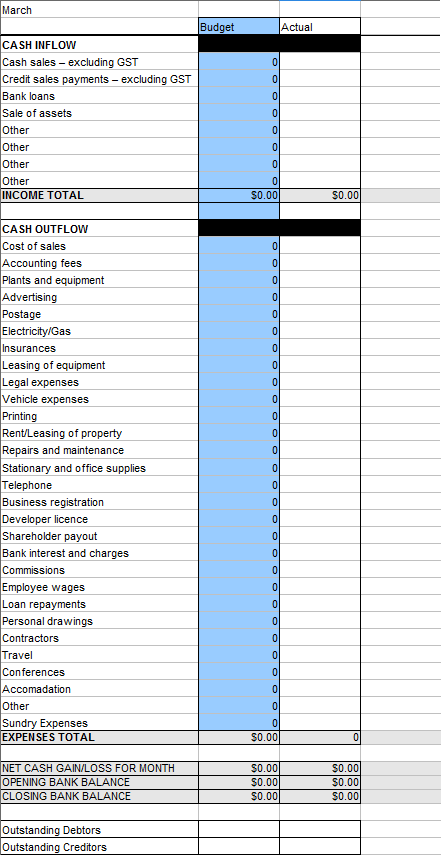
Cash flow Example
A cash flow statement has 5 main sections.
Income – self explanatory
Expenses – self explanatory
Summary – Total Income – Total Expenses
Outstanding Debt – If you owe any money that has not been paid yet
Outstanding Credit – If clients owe you money that has been invoiced but not yet received
Each section has sub-sections which should be self explanatory and easy to understand. These sub-sections will be slightly different depending on the business. The sub-sections are just to categorise your inflow and outflow of cash.
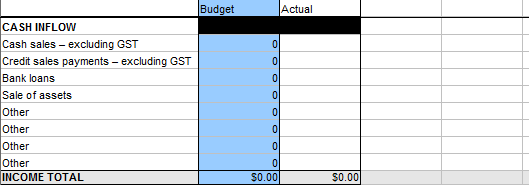
Income Section
If you followed my tips from the previous post I mentioned then the rest should be pretty simple. You can look in the ‘Paid’ folder for all your monthly income and check your receipts folder for all expenses. You should be able to fill out your Income and Expenses sections. Obviously once that is done you can jump straight to completing the Summary.
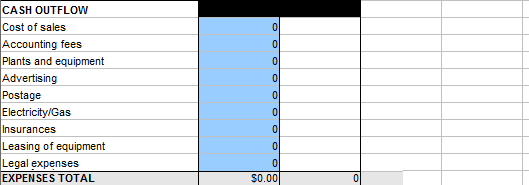
Expense Section
A quick note – depending on how late in the month a transaction occurs, it might not show up in your bank statement for the month. Only transactions that are present on the bank statement should be used in your monthly cash flow.

Summary Section
Outstanding Debt is calculated from the invoice(s) you have received from purchases. This shows how much money you still owe other people/businesses. Similarly, adding up all the invoices you have issued which have not been paid yet will give you a value for Outstanding Credit.

Outstanding Debtors and Creditors Section
After all that – YOU’RE DONE!!!!! Congratulations, you have completed your monthly cash flow and bank reconciliation. Time for a small victory dance before you remember you have to do it all over again next month.
There are programs out there that you can buy to make this process faster and easier. What we have notice though, is that most months we don’t have a huge amount of transactions and it is just easier for us to work with an excel sheets ourselves than use a more complicated program. Although we are getting to the stage where we are looking at alternatives like QuickBooks or Xero.
If you are not doing your cash flow statements for you company, you are losing out. You need to do it so you have an informed idea of where your company stands from a financial point of view. There really is no excuse not to do it. How useful do you think a cash flow statement is?

0 Comments to "Cash Flow and Bank Reconciliation"